


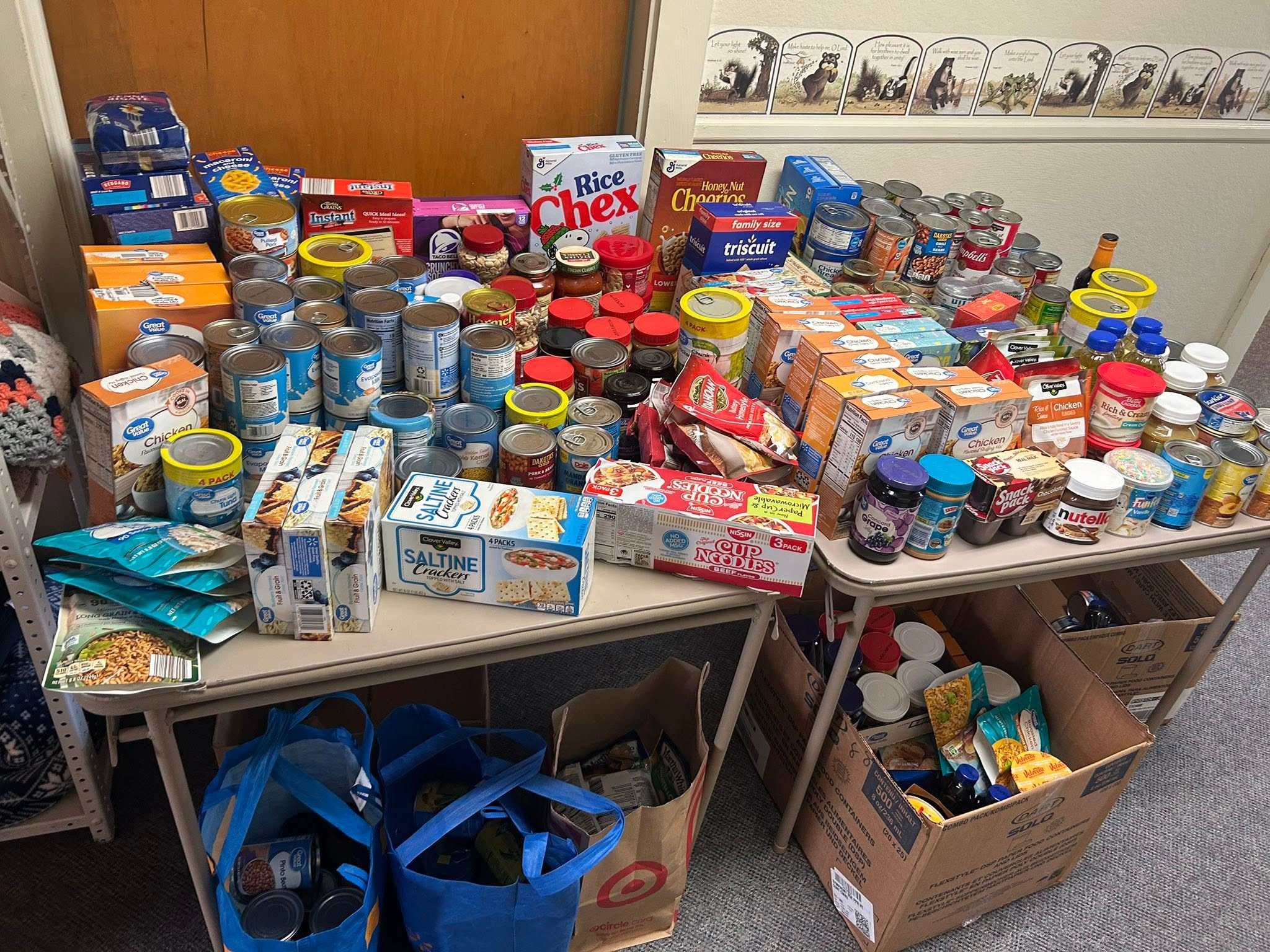
Harmony Food Pantry in Waterloo is serving dramatically more families than it did just a few years ago, with board members saying rising household costs, transportation barriers and changing economic circumstances are pushing people who once managed on their own to seek help.
Board members Claudia Faust and Rebecca Carson said the pantry now serves roughly 20 to 30 families during a typical Saturday distribution, compared with only a handful per week several years ago. Carson said the pantry served 19 families during the entire month of August five years ago. On one recent Saturday, 23 families came through its doors.

The increase isn’t being driven only by people who have relied on food assistance for years. Carson said the pantry is regularly seeing households that have never needed community assistance before, including people who had been living paycheck to paycheck until increasing rent, food and other expenses pushed their budgets past the breaking point.
“We’re averaging at least three new families every single week,” Carson said, compared with roughly three to five total families per week about five years ago.
Harmony Food Pantry operates from First Presbyterian Church at 42 E. Main St. in Waterloo and serves Seneca County residents. It is open from 9:30 to 11 a.m. Saturdays, and clients can receive groceries twice per month.
The people seeking help are changing

Carson said one of the biggest misconceptions surrounding food insecurity is the assumption that pantry clients fit a particular profile.
“It’s your neighbor that’s coming in that couldn’t make the macaroni and cheese stretch to the end of the month,” she said.
Some are single-person or two-person households. Others are families facing ordinary expenses that have become increasingly difficult to absorb.
Faust said the decisions clients describe can be stark: whether to pay rent or buy groceries, purchase medication or food, pay a gas bill or buy food, or purchase school shoes for children while keeping enough money available for meals.
Carson pointed particularly to housing costs. Apartments that could once be found for several hundred dollars per month may now cost around $1,000, she said, while household income hasn’t necessarily increased at the same pace.
The pantry’s experience has also challenged perceptions about where food insecurity exists in Seneca County. Faust and Carson said some residents remain surprised by how much need exists in Waterloo and the northern part of the county.
“It’s right here in our neighborhood,” Faust said.
Harmony Food Pantry began in 2012 as a church-based effort involving several Waterloo-area congregations. It gradually expanded beyond the participating churches and now serves people from across Seneca County.
Transportation adds another barrier
Having food available doesn’t necessarily mean people can easily reach it.
Carson said transportation has become another major issue for people using community resources in Seneca County, including in Waterloo and the county’s more populated northern communities.
“Not everybody can afford a car,” she said. “We’re rural.”
Some Harmony Food Pantry clients arrive on bicycles or on foot. Others carpool or use carts to carry groceries home.
Faust described one client who travels by bicycle with a backpack. Pantry clients can choose up to 25 items during each visit, and additional donated products are sometimes available without counting against that limit.
On weekends when donated milk is available, that can mean trying to carry a gallon of milk in addition to a backpack filled with groceries.
The difficulty becomes more pronounced during weather extremes. Carson said carrying frozen food home on foot during a 90-degree day creates one problem, while making the same trip during a Finger Lakes winter creates another.
Pantry puts an emphasis on choice and dignity
Harmony Food Pantry’s approach is designed to give clients more control over what they take home.
Rather than distributing a prepacked box, the pantry provides a list of available items and allows clients to choose up to 25 products based on what they will actually use.
Carson said that reduces waste and avoids sending people home with food they don’t need or won’t eat.
“If you walk through our door, you don’t have to tell us the why,” she said. “We’re just there to give you what you need.”
New clients complete a simple application and must establish that they live in Seneca County. Faust said the pantry tries to keep that process private and straightforward.
Clients are also given information about other food pantries and assistance programs in the county. Carson said Harmony doesn’t object to people using other food programs in addition to its own.
“If our rule is you can hit all the other ones and still come to us,” she said, “we try to inform clients as best I can so that they have access to the things that they need.”
Faust said pantry volunteers also work to remove the embarrassment that can accompany asking for help.
The physical space is small enough that only a few households can be inside at once, but Faust said volunteers try to make the experience resemble shopping as much as circumstances allow.
“We want to make them feel like they’re going shopping,” she said.
Hygiene products and basic cooking supplies remain in demand
The pantry accepts food, monetary donations, fresh produce, personal care products and other household necessities.
Carson said some of the most difficult items to keep stocked are products that cannot generally be purchased with Supplemental Nutrition Assistance Program benefits, including toilet paper, shampoo, conditioner, soap, toothpaste, toothbrushes, razors and dish soap.
Those costs create another tradeoff for struggling households.
“Do I buy hamburger that I can probably make three or four meals out of, or do I buy dish soap?” Carson said.
Basic cooking ingredients such as flour, sugar, brown sugar and cooking oil are also consistently needed.
Faust said another growing concern is the need for foods that don’t require a stove or oven. Some clients have told pantry volunteers they don’t have the ability to cook in their apartments, increasing demand for canned meats, tuna, peanut butter, jelly and other foods that can be eaten with little or no preparation.
The pantry’s broader donation list includes cereal, macaroni and cheese, pasta, rice, soup, pasta sauce, peanut butter, canned meats, canned fruit and vegetables, broth, oatmeal and baking mixes, along with diapers, feminine hygiene products, baby wipes and other personal care items.
Sponsor-a-Shelf campaign seeks more community support
Harmony Food Pantry is using September’s hunger awareness efforts to promote its Sponsor-a-Shelf initiative.
Businesses, organizations and individuals can sponsor pantry inventory either by making a monetary donation that volunteers use to purchase products or by organizing collections around a particular category, such as soup.
The pantry also relies on other fundraisers and partnerships.
Carson said Doug’s Fish Fry has supported pantry fundraising efforts, while volunteers operate a bake sale at the Waterloo Recreation Center on Election Day. The pantry has also received support from organizations including the Bonafiglia Foundation and United Way, and it works with Hobart and William Smith Colleges students through service programs.
The pantry has 28 volunteers on its roster, but Carson said that number doesn’t mean 28 people are available every Saturday. Some can only volunteer once per month, some spend part of the year outside the area and others have seasonal work that limits availability.
“We’re always trying to look for new volunteers,” she said.
Even someone who can help only once every couple of months can make a difference, Carson said.
Demand hasn’t returned to earlier levels
What concerns pantry leaders most is that the increase in need hasn’t proven temporary.
Carson said Harmony saw a sharp increase during a period when SNAP benefits were disrupted, and community donations surged in response. She expected demand to fall substantially after benefits returned.
It did decline somewhat, she said, but not nearly as much as anticipated.
“We are averaging between 20 and 30 families every single week,” Carson said. “Sometimes we tip that scale a little bit up into the 30s.”
Faust calculated that the 23 families served during one recent two-hour Saturday distribution could select as many as 575 regular pantry items combined.
That figure didn’t include free items available outside the 25-item limit or products such as milk and eggs that were distributed without counting against the limit.
“It’s not getting any better,” Faust said.
Despite the trend, Carson said she remains confident the broader Seneca County community will continue responding when organizations ask for help.
“I have faith in our community,” she said. “When our community needs, our community steps up to the challenge.”
Donations can be brought to the pantry during regular Saturday hours, and arrangements can be made for donations at other times. Harmony Food Pantry also maintains a website at harmonyfoodpantry.org and a Facebook page where residents can contact the organization or learn more about current needs.

FingerLakes1.com is the region’s leading all-digital news publication. The company was founded in 1998 and has been keeping residents informed for more than two decades. Have a lead? Send it to news@fingerlakes1.com.